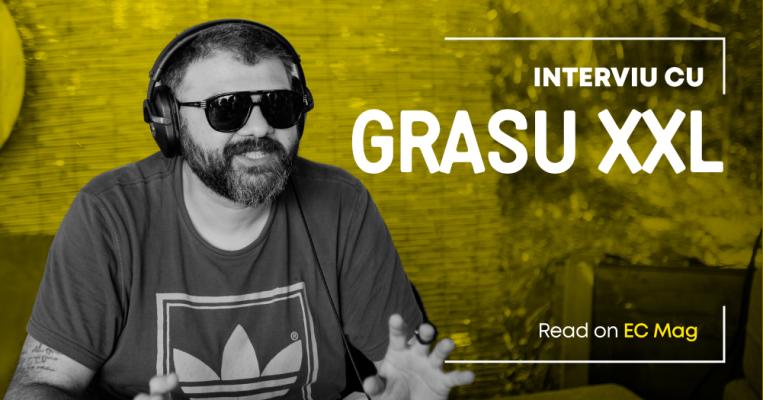
This is the second year you’re involved in Creative Camp. How was this edition incomparison with the first?
Last year’s edition of Creative Camp was like a breath of fresh air for artists. It helped us create a 100% artistic community where we could sing and spend time together all day long. And the fact that we didn’t have a goal helped a lot. Whether we could write a song or two during that week was less important. The experience alone was enough.
For this year, the rules regarding the end product have changed a bit. The goal was to reimagine and reinterpret some old Romanian songs. We had less than a week to do it. So, the outset was different. The pressure was high, we had to deliver a song by the end.
Considering that you had to deliver a song by the end, has the vibe among Creative Camp artists changed?
Creative Camp manages to detach you from reality. During that week, it feels like you’re not on Earth, but in a utopian place. You’re in a perfect life where the only thing that matters is the relationship with the others and music. The truth is that such camps are organized very rarely. So the enjoyment of being part of such a project was so intense that you no longer had time to think about the nasty things going on in your life. There were people there with an immense longing to sing. They would barely sleep. They would sing from morning till late at night.
How do you like the role of mentor? Do you think it befits you?
I don’t see myself as a mentor. I wouldn’t open a school for young artists. But I am somehow very good at it. I’m a 100% self-taught artist and I’ve done a lot of good things and bad thing, but I always tried to learn from my experiences. Throughout my career I developed both my artistic and my producer/sound engineer skills. In addition, in all these years I’ve managed to get rid of my artistic pride, of the feeling that everything I do is awesome and infallible. I gave away these things. I do a very democratic mentoring.
You mentioned that you’re a self-taught artist, but I wonder if you ever had a mentor who helped you with your career.
I had many mentors. Unfortunately, not in real time. One of them is Titus Munteanu, the producer and creator of the concept behind Școala Vedetelor. We didn’t get along at all during our collaboration. But afterwards, he became my best friend. He’s the one who told me “well, why don’t you make your own music?”. And I was like, “dude, why don’t I make my own music?”. But I didn’t realize he was a mentor until later, when he was no longer had that role. At the same time, I’d say that my mentors are all the bands I’ve listened to. I’ve been seriously bitten by the rock bug. I believe 100% in it. I became obsessed. I listened to everything analytically.
Why did you choose Doru Stănculescu’s song, Shambala?
I’m a big fan of Romanian music. I grew up during the communist years when we got only two hours of TV a day and the national TV station only broadcast Romanian music. I know all the artists, composers, lyricists, I recognize the songs. And I have a big respect for my predecessors. Regardless of their genre. A good musician cannot exist without those who paved the roads they walk on.
I was thinking of songs that we could reorchestrate, we had several variants, but a week prior, we randomly came across some of Doru Stănculescu’s songs, most notably a recording of him performing Shambala. I was taken aback. I thought that it was so cool to have someone like Doru Stănculescu singing ‘world music’ during those days. He sang a song about an imaginary world inhabited by gods. What?! During the communist years? Unbelievable.
Did the Creative Camp people have the same reaction when you showed them the song?
When we arrived in the Camp, I presented them the options, Irina from Temple made a demo inspired by Aura Urziceanu, very cool, we were supposed to do that one as well, but we ultimately agreed on Shambala. What followed was pure madness. We were singing, writing guitar sheets, writing lyrics, reorchestrating all day long. Then came along a guitar player from the production team, a videographer, who said that he had a shepherd’s pipe. Later, the bartender brought a darbuka. It was crazy. Whatever we did became a magnet for everyone present. We were growing more numerous by the day. I never expected things to turn out so well. I’m very happy I managed to attract so many people in this project.
In your opinion, what is the most valuable lesson that the Creative Camp artists learned from you?
Dedication and passion, I think. My maturity may have broken their plans to play. The schedule was very tight. In the first two days, when we organized a few jam sessions, were very cool and pleasant. We laughed and performed. When we started recording, things got more serious. This meant a fixed working schedule, there were no more excuses of tiredness or other kind. I take things very seriously because music requires these two elements: pleasure and professionalism. The end product will suffer if one or the other is missing.
What did you learn from the young Creative Camp guys who want to do music?
I always get my share of hope and energy from young artists. I am tempted to say that the new generation is weak. That they have a questionable artistic taste, more rooted in entertainment than in art. But I am wrong. Every time I interact with reality, I see young people who are crazy about experimenting and who are willing to escape their comfort zone.
Rock is a music genre where collaboration is key. At the same time, inspiration often comes in solitary moments. Do you prefer writing in a studio, with your colleagues or in solitude?
Most songs are conceived in my home studio, which is a tiny, enclosed balcony, very similar to the room I grew up in. This is where most guitar ideas are born. I then take them to the studio where we develop, shape, and record them. Then we make a premix, I take the track back home where I write the melody and lyrics. I return to the studio, I record and start to produce it, mix it, spin it around. After all this process, we have to relearn the song from scratch. It changes so much that it hardly resembles the initial recording. It is a very winding path. I am perhaps not as talented as I am hard working. It takes me quite a lot of time to process them. I need a few good months of reflection and analysis.
Vița de Vie was involved in last year’s Bonțida jam session with Subcarpați and Golan, where you wrote the song 84-85, now you will release the Șambala cover. Are there going to be world music influences on the new Vița de Vie material?
It's very possible. My relationship with world music started in 2009. I had the idea of releasing and acoustic Vița de Vie album. For two years, I’ve only listened to folk, indie, psychedelic stuff. I’ve also bought a bunch of mandolins, and Irish instruments, it was madness. It was during that time that I befriended world music. Following the acoustic album, I had a hard time returning to demons, to hard-core rocking. I became a new person.
Do you know what I enjoy most about world music? In the entire music industry, including trap, rock, EDM, electro and metal, the computer aggressively influences emotion. All this perfection erases the human factor. It erases errors, mistakes, breaths, delays, all the things that humanize music. These are all conspicuous in world music. Those people sing all at once, there is no way you can edit what they sing. I search for these human traces in music. It is my lifebuoy. I would love to collect folklore somewhere in the mountains, not the kind that you see on TV, it’s one of my dreams.